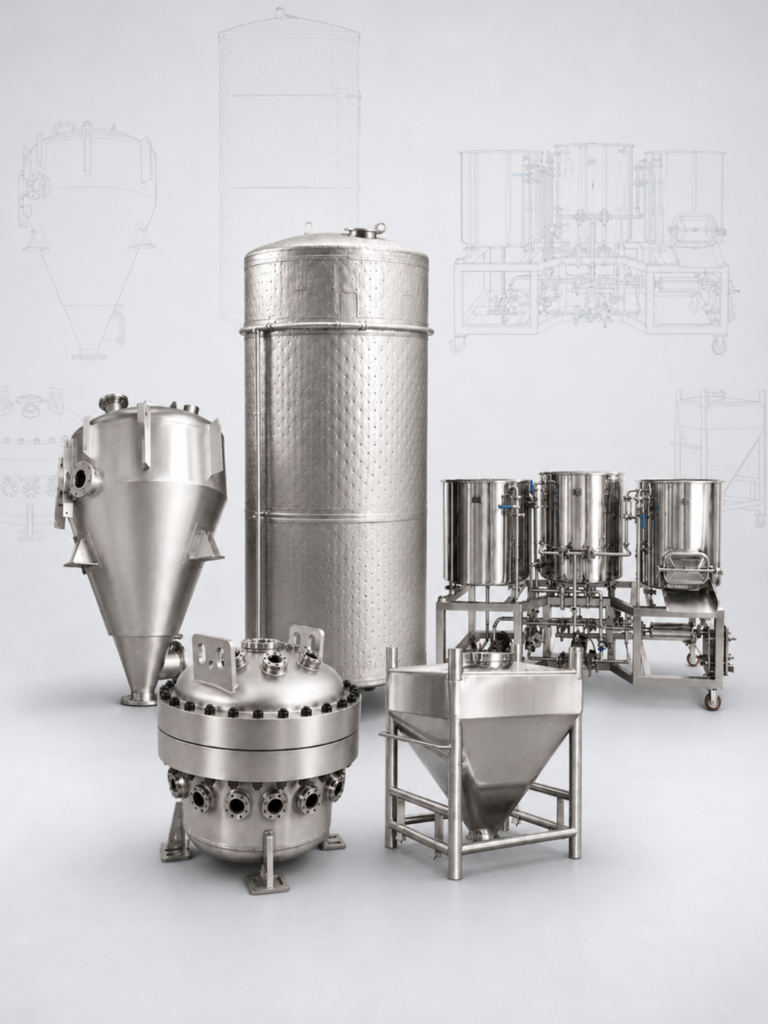
Custom Stainless Steel Equipment

Custom Stainless Steel Equipment Built Around Your Process

Custom silos, vessels, IBC containers, jacketed systems, pressure-related equipment, fermentation tanks, and accessories designed around material behavior, product-contact requirements, process conditions, installation space, and connection details.

Customization starts from the real operating condition.
Material or product characteristics, capacity, temperature, pressure, discharge behavior, cleaning method, sanitary requirements, interfaces, and export delivery requirements should be reviewed together.
Custom stainless steel silos vessels IBC containers fermentation tanks and process equipment
Process Review
Material, product and operating conditions
Custom Design
Structure, interfaces and accessories
Export Delivery
Packing and project documents
Why Customization Matters

Process equipment should fit the real operation, not force the operation to fit a standard model.

Many stainless steel equipment projects cannot be solved by choosing a standard model. Material flow, product-contact requirements, sanitary cleaning, pressure or temperature conditions, installation space, upstream equipment, and downstream interfaces may all affect the final structure.

Customization helps review these details before fabrication, so the equipment can support storage, transfer, discharge, fermentation, heating, cooling, inspection, cleaning, monitoring, and export delivery in a more practical way.

Key design question
What should the equipment support in daily production, and which process conditions may affect its structure, fittings, surface finish, or connection details?
Customization Scope

What Can Be Customized

Custom equipment design can cover dimensions, structure, material, finish, interfaces, accessories, sanitary requirements, process conditions, and project documentation according to actual production needs.

01

Volume and Dimensions

Total volume, working volume, headspace, diameter, height, footprint, and installation clearance.

02

Material and Surface Finish

SS304, SS316L, internal polishing, pickling, passivation, hygienic finish, or special product-contact surface.

03

Cone, Outlet and Discharge

Cone angle, outlet size, valve type, flow aid, feeder connection, yeast dump, drainage, and residue control.

04

Temperature or Pressure Conditions

Jacket, insulation, heating, cooling, glycol jacket, pressure, vacuum, sealing, and safety interfaces if required.

05

Agitator or Internal Structure

Agitator, internal supports, baffles, spray balls, CIP cleaning devices, cone bottom, or special internal arrangements.

06

Nozzles, Ports and Interfaces

Inlet, outlet, vent, drain, manway, inspection port, sensor port, CIP, sampling, dry hop port, racking arm, and piping connection.

07

Support and Installation

Legs, skirt, frame, base plate, mobile base, lifting points, access platform, cellar layout, and site clearance.

08

Accessories and Monitoring

Conveyors, valves, filters, level sensors, weighing modules, pressure instruments, temperature sensors, sanitary fittings, brewery fittings, and control interfaces.

09

Documentation and Export Packing

Drawing confirmation, material certificates, inspection photos, surface finish records, packing photos, and export documents.

Start With What You Know

No Complete Drawing Yet? Start From Product, Process, and Layout Details

A custom equipment review does not always need a finished drawing at the beginning. Basic product, material, process, capacity, and installation information is often enough for the first technical discussion.

After the initial review, the equipment structure, dimensions, openings, surface finish, accessories, sanitary fittings, and export packing plan can be developed step by step.

Material or product characteristics Required volume, working volume, or batch size Loading, discharge, transfer, or yeast handling method Temperature, glycol cooling, or pressure condition Cleaning, CIP, and surface finish requirement Available installation space or cellar layout Existing equipment, piping, or utility interface Drawings, sketches, reference photos, or preferred fittings
Engineering & Quality

From Custom Review to Fabrication and Export Delivery

Custom equipment projects need careful coordination between process requirements and manufacturing details. Material, structure, nozzles, supports, finish, accessories, documents, and packing should be reviewed before production starts.

Confirming these details early helps reduce late changes to dimensions, openings, interfaces, supports, surface finish, or packing method during fabrication and shipment preparation.

01

Review

Material, capacity, process condition, site layout, cleaning, and connection needs are reviewed before the design direction is confirmed.

02

Drawing

Main dimensions, openings, supports, interfaces, and key technical details are confirmed before fabrication.

03

Fabrication

Manufacturing follows confirmed drawings, including welding, dimensions, surface treatment, and interface details.

04

Inspection & Packing

Key details are checked before delivery, and export packing is arranged according to equipment size and shipment needs.

Project documents can be prepared as required.

Drawing Confirmation Material Certificate Inspection Photos Surface Finish Check Packing Photos Export Documents
FAQ

Frequently Asked Questions

Common questions before starting a custom stainless steel equipment project.

What information is most helpful for the first review? +
Material name, required capacity, process purpose, loading method, discharge method, cleaning requirement, available installation space, and any existing equipment interface are usually enough for the first discussion.
Can the equipment be designed around an existing production line? +
Yes. Existing equipment drawings, layout sketches, site photos, flange dimensions, outlet height, available space, and nearby equipment information can help review the most suitable structure and connection method.
How is the final structure confirmed before fabrication? +
The main dimensions, openings, nozzles, support method, outlet arrangement, surface finish, and connection interfaces are normally confirmed through drawings before production starts.
Can one project include several equipment types? +
Yes. A project may include silos, vessels, IBC containers, hoppers, discharge components, conveyors, filters, sensors, or other accessories depending on the process layout.
Can documents and inspection records be prepared for export projects? +
Project documents can be prepared according to order scope, such as drawing confirmation, material certificates, inspection photos, surface finish checks, packing photos, and basic export documents.
Start Your Project Review

Tell Us What You Need

Share a brief requirement, drawing, photo, or application idea. We will review the basic details and help clarify the next step.

You do not need a complete specification to start the discussion.

Helpful Details, But Not Required

  • Material or product to be handled
  • Approximate capacity or size
  • Process purpose or equipment type
  • Drawing, layout, photo, or reference file