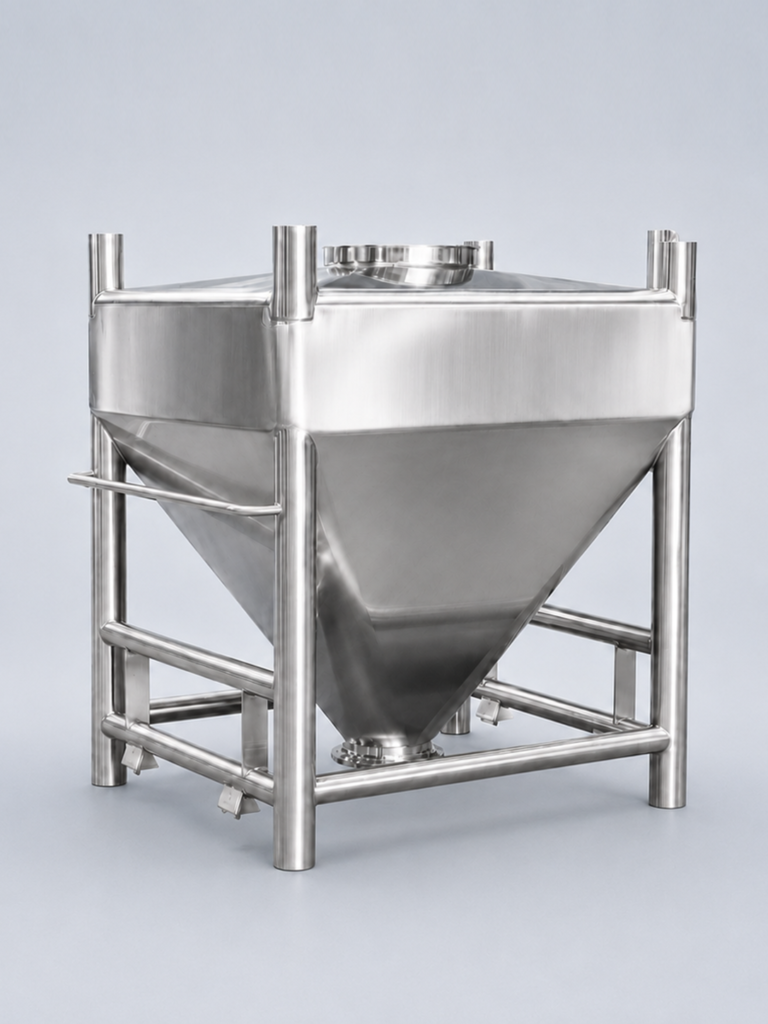
Intermediate Bulk Containers

Custom Stainless Steel IBC Containers for Material Storage and Transfer

Designed for controlled material handling between production steps, including temporary storage, batch transfer, discharge, and connection with nearby process equipment.

The focus is not only the container body.
Volume, outlet, valve, frame, lifting method, cleaning access, surface finish, and process connection should be reviewed together.
Custom stainless steel IBC container
Storage
Temporary material holding
Transfer
Batch movement between steps
Connection
Outlet and interface matching
Why IBC Design Matters

Material movement is part of the process, not just logistics.

A stainless steel IBC is often placed between production steps. It may receive material from upstream equipment, hold it temporarily, move it to another area, and discharge it into a mixer, reactor, silo, conveyor, or filling machine.

The container should match the material, cleaning method, handling method, outlet arrangement, and connection interface. Otherwise, a simple container can become a bottleneck in the process.

Key design question
How will the material be filled, moved, cleaned, discharged, and connected to the next step?
Three Common Process Needs

Store, Move, or Discharge Materials Under Controlled Conditions

Most IBC projects start from one of three practical needs. The final structure depends on how the material moves through the production process.

Store

When material needs temporary holding between steps

The IBC can be used as an intermediate container before mixing, feeding, packing, or further processing.

Design focus
Volume, lid, sealing, cleaning access, and surface finish
Move

When material needs to move across production areas

Forklift pockets, lifting lugs, mobile frame, stacking structure, and handling clearance should be reviewed together.

Design focus
Frame, lifting, forklift access, stability, and protection
Discharge

When material needs controlled feeding to the next process

Outlet size, valve type, bottom shape, flow behavior, and downstream connection affect how smoothly the material discharges.

Design focus
Cone, outlet, valve, flexible connector, and interface
IBC Structure Explained

The Container Body, Frame, and Outlet Should Work as One Unit

An IBC container needs to match both the material and the way it is handled on site. The body, cover, frame, discharge outlet, and interfaces should be reviewed together.

Stainless steel IBC container structure with body frame and outlet
What We Review

Each part affects filling, movement, cleaning, and discharge.

The container body holds the material. The frame supports handling. The outlet controls discharge. The cover, ports, and interfaces affect cleaning, protection, and process connection.

Body
Round or square structure, working volume, top opening, lid type, and internal finish are reviewed according to material and cleaning needs.
Bottom
Conical, sloped, or customized bottom can be selected according to discharge behavior and residue control.
Frame
Forklift pockets, lifting lugs, support frame, mobile base, or stacking design can be reviewed according to handling method.
Interfaces
Outlet valve, flange, vent, sensor port, CIP port, and downstream connection can be arranged according to process layout.
Material Flow Review

Discharge Performance Depends on More Than the Outlet

For many materials, the outlet size alone does not decide whether discharge is smooth. Flow behavior, bottom shape, valve type, filling ratio, residue tendency, and downstream connection all matter.

Before confirming the IBC structure, it is better to review how the material behaves during storage, movement, discharge, and cleaning.

Design focus
The container should help the material leave the IBC cleanly and enter the next process without unnecessary blockage, residue, or handling steps.
Material
Powder, granule, liquid, paste, flowability, stickiness, compacting tendency, and residue behavior affect the container design.
Bottom
Cone angle, sloped bottom, outlet position, and internal transition should match the way material leaves the container.
Valve
Butterfly valve, ball valve, rotary valve interface, or customized outlet can be selected according to discharge control needs.
Connection
The outlet may need to connect with mixers, conveyors, silos, filling machines, or flexible connectors.
Cleaning
Internal corners, outlet area, cover design, surface finish, and cleaning access should be reviewed to reduce residue.
Technical Parameters

Information Needed Before IBC Container Design

The following details help review the IBC structure, outlet, handling method, surface finish, and process connection.

01

Material & Process

  • Material name, form, bulk density or viscosity
  • Flow behavior, residue risk, stickiness, or compacting tendency
  • Use purpose: temporary storage, transfer, feeding, or discharge
02

Volume & Dimensions

  • Total volume, working volume, or batch weight
  • Height, width, footprint, and available handling space
  • Filling ratio, stacking condition, or shipping limitation if any
03

Handling Method

  • Forklift movement, lifting, mobile base, fixed placement, or stacking
  • Required clearance, lifting condition, and workshop route
  • Support frame, base structure, or protection requirement
04

Outlet & Discharge

  • Outlet size, valve type, discharge direction, and flow control need
  • Connection with mixer, silo, conveyor, filling machine, or flexible connector
  • Need for reduced residue or easier outlet cleaning
05

Finish & Interfaces

  • SS304, SS316L, or other material requirement
  • Internal polishing, external finish, sanitary connection, or easy-clean requirement
  • Vent, sensor port, CIP port, lid type, and access opening if required

A rough process description is enough to start.

If drawings are not ready, you can first share the material, volume, handling method, outlet preference, and equipment connection. The detailed IBC structure can be reviewed later.

Stainless steel IBC container applications in process facilities
Typical Applications

Used When Material Needs Controlled Movement Between Process Steps

Stainless steel IBC containers are commonly used where materials need temporary storage, clean transfer, controlled discharge, or batch movement between processing areas.

The same container volume may require a different body shape, outlet, valve, frame, or surface finish depending on material behavior and cleaning requirements.

Food Ingredients Powders & Granules Pharmaceutical Materials Fine Chemicals New Materials Batch Transfer Temporary Storage Process Feeding
Engineering & Quality

From Requirement Review to Fabrication and Export Delivery

An IBC container project needs practical review of material handling, outlet design, frame structure, cleaning access, surface finish, and packing method before production starts.

This helps reduce late changes to dimensions, lifting points, outlet interfaces, or packing requirements during fabrication and delivery preparation.

01

Review

Material, volume, discharge, cleaning, handling method, and process connection are reviewed.

02

Drawing

Main dimensions, body shape, outlet, frame, lifting points, and interfaces are confirmed before fabrication.

03

Fabrication

Manufacturing follows confirmed drawings, including welding, frame structure, surface treatment, and outlet details.

04

Inspection & Packing

Key details are checked before delivery, and export packing is arranged according to container size and shipping needs.

Project documents can be prepared as required.

Material Certificate Drawing Confirmation Inspection Photos Surface Finish Check Packing Photos Export Documents
FAQ

Frequently Asked Questions

Common questions before starting a custom stainless steel IBC container project.

Can the IBC container be customized for a specific material? +
Yes. Volume, body shape, outlet, valve, frame, surface finish, and handling method can be reviewed according to material characteristics and process needs.
What information is needed for quotation? +
Material type, required volume, bulk density or viscosity, discharge method, handling method, cleaning requirement, and equipment connection details are helpful for the first review.
Can the IBC connect with mixers, silos, conveyors, or filling machines? +
Yes. Inlet, outlet, flange, valve, flexible connector, vent, sensor port, and downstream interface can be arranged according to the production layout.
Can SS304 or SS316L be selected? +
Yes. SS304 and SS316L are commonly used. The final material should follow the handled material, cleaning method, corrosion condition, and hygiene requirement.
Can the internal surface be polished? +
Yes. Internal polishing, mirror finish, pickling, passivation, or hygienic finish can be selected according to cleaning and product-contact requirements.
Can the container be designed for forklift or lifting operation? +
Yes. Forklift pockets, lifting lugs, support frame, mobile base, and stacking structure can be reviewed according to handling method and site conditions.
Can the design help reduce residue during discharge? +
Bottom shape, outlet position, internal transitions, valve type, and surface finish can be reviewed to support smoother discharge and easier cleaning.
Can export packing and documents be supported? +
Yes. Export packing, packing photos, material certificates, inspection photos, and basic shipment documents can be supported according to order requirements.
Start Your IBC Container Review

Tell Us How the Container Will Be Used

Share your material, volume, handling method, discharge requirement, cleaning need, or connection details. We will help review the basic IBC direction.

You do not need a complete specification to start the discussion.

Helpful Details, But Not Required

  • Material and approximate container volume
  • Forklift, lifting, mobile, or fixed use
  • Outlet, valve, frame, or cleaning requirement
  • Drawing, layout, photo, or reference file